

Best Peptides for Eye Health and Vision Support After 50
By Vlad. Last updated May 2026.
Quick read
Visoluten is the retinal peptide bioregulator. It is the starting point for most eye health protocols. Available in capsule and sublingual lingual forms.
Vision 3 is a peptide complex that supports the whole visual system, the brain, and the blood vessels that feed the eyes.
The Visual Organ Bundle pairs Visoluten with Cerluten and Ventfort for a fuller eye, brain, and circulation protocol.
Most people start with Visoluten 60-cap for a 90 day cycle and add the bundle on the next round if they want broader support.

Why vision changes after 50
Most people notice small changes in their eyes by their late forties. Reading menus gets harder. Glare from headlights feels stronger at night. Screens leave the eyes tired by mid afternoon. The print on prescription bottles starts to win.
These are normal age related changes. The cells in your retina, your lens, the optic nerve, and the small blood vessels that feed your eyes all slow down with time. Protein synthesis drops. Oxidative stress builds up. Blood supply to the back of the eye loses some of its efficiency. The lens stiffens. The whole visual system needs more support than before.
Khavinson peptide bioregulators help here. They are short chains of amino acids that act like signals to your own cells. Each one is tissue specific. Visoluten signals retinal cells, including photoreceptor cells. Cerluten signals brain cells. Ventfort signals the cells that line your blood vessels. Together they support the systems that vision depends on.
If you are new to peptide bioregulators, start with our primer: Khavinson Peptides Explained: How They Work and Who They're For. The short version below will get you to the right product faster.
The three options for eye health, at a glance
Here is what we carry for eye health, ranked by how most people use them. Tap any product name for full product details.
| Product | Form | Best for | Typical dose |
|---|---|---|---|
| Visoluten 20-cap | Capsule | First protocol, 30 day cycle | 1-2 caps with meals, 20-30 days |
| Visoluten 60-cap | Capsule | 3 month protocol | 1-2 caps with meals, 60-90 days |
| Visoluten Lingual | Sublingual drops | Faster absorption, travel friendly | 6-10 drops daily under the tongue |
| Vision 3 | Complex capsule | Whole visual system support | 2 caps daily, 30 days |
| Visual Organ Bundle | 3-peptide stack | Full protocol with brain and vessels | 1-2 caps of each with meals, 30 days |
The rest of this guide explains how to choose between these options and how to use them together.
Visoluten: the foundation for retinal cell support
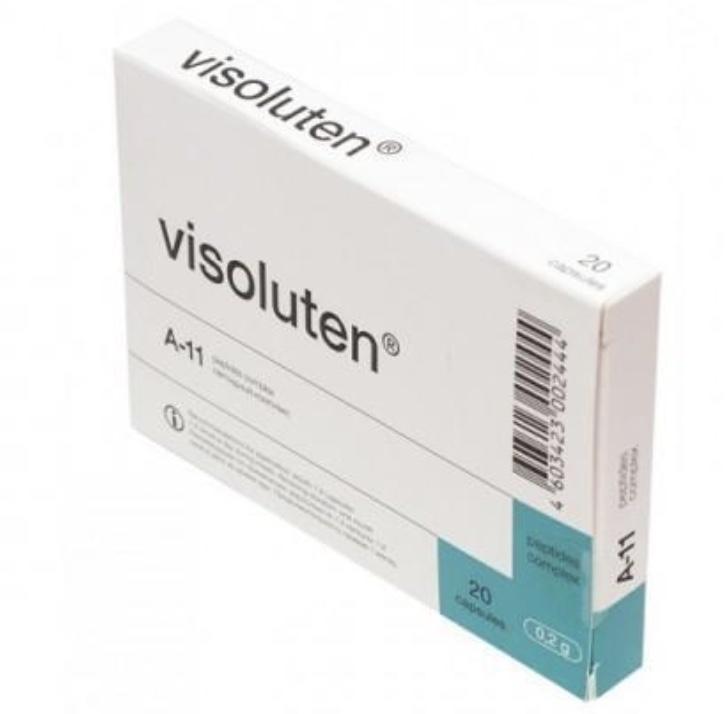
Visoluten is the A-11 peptide bioregulator. It targets the cells of the retina, the layer at the back of the eye that turns light into the signals your brain reads as vision.
Each retinal cell has a job. Photoreceptor cells detect light. Pigment epithelial cells clear waste and protect the photoreceptors from oxidative damage. Ganglion cells pass the signal through the optic nerve to the brain. As we age, all of these cell types slow down. Visoluten gives them a signal to keep working the way they did when they were younger. The peptide itself is a short chain of amino acids, which is why it can act as a signal rather than as a nutrient.
The science behind this comes from the work of Vladimir Khavinson and his team at the St. Petersburg Institute of Bioregulation and Gerontology. Their published research has explored how short peptide chains support retinal cells in animal models and in older adults [Khavinson et al., 2014, PMID 25272779]. The broader theory of tissue specific peptides is laid out in Khavinson's review "Peptides and Ageing" [PMID 12374906].
Visoluten capsule vs sublingual: how to choose
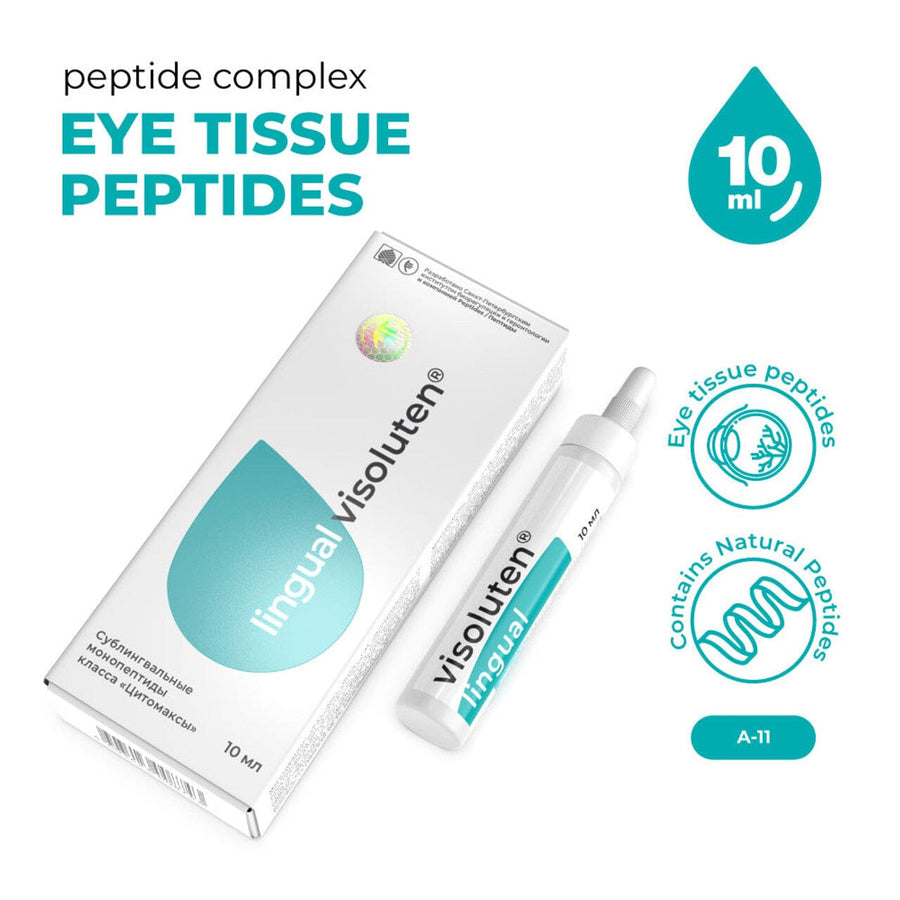
Two delivery forms. Same active peptide. The choice depends on how you want to take it.
Capsules are the standard. Visoluten 20-cap is the right pick for a single 30 day cycle. Visoluten 60-cap is the right pick if you plan to run a 60 to 90 day protocol. Capsules are taken 1 to 2 times per day with meals. They dissolve and release the peptide through the digestive tract.
Sublingual drops are absorbed faster. The Visoluten Lingual form is placed under the tongue, where the tissue absorbs the peptide directly into the bloodstream. This bypasses the stomach and starts working in minutes. Many people choose the lingual when they travel, when they have trouble swallowing pills, or when they simply prefer a faster onset.
Both forms deliver the same A-11 peptide. The capsule is the right starting point for most people. If you have used Khavinson peptides before and want the faster delivery, the lingual is the upgrade.
Ready to start your eye health protocol?
Most people start with Visoluten 60-cap for a 90 day cycle. It is the simplest way to test the protocol before stepping up to the full Visual Organ Bundle.
Vision 3: the whole system option

Some people want one capsule instead of three. Vision 3 is built for that.
It is a complex peptide formula. Instead of one tissue specific peptide, it combines several peptides that support the whole visual system. The retinal peptide is in there. So are peptides that support the brain pathways that process vision and the small blood vessels that feed the eyes.
This is the right pick if any of the following are true:
- You want a simpler daily routine with one capsule instead of three
- You are not sure which single peptide to start with
- You want broad support without building a multi product stack
- You are buying for a parent or relative who would not stick to a three peptide protocol
If you want the targeted single peptide, choose Visoluten. If you want the all in one, choose Vision 3. Both are valid.
The Visual Organ Bundle: the full protocol

If you want to do this properly and you are ready for a multi peptide stack, the Visual Organ Peptide Bundle is what we recommend.
The bundle pairs three peptides:
- Visoluten (A-11) supports the retina
- Cerluten (A-5) supports the brain pathways that process what the retina sees
- Ventfort (A-3) supports the small blood vessels that feed the eyes
Why three peptides instead of one? Because vision is not just the eyes. The retina sends a signal. The brain reads it. The blood vessels keep both fed. If any one of these three slows down with age, the whole system feels it. The bundle works on all three at once.
Khavinson's research framework calls this a "system protocol" because it targets the connected tissues that work together to produce a single function. For the science behind the related nervous system protocol, see Khavinson Nervous System Stack: Cerluten, Ventfort, and Svetinorm.
Dosing for the Visual Organ Bundle: 1 to 2 capsules of each peptide per day with meals, for 30 days. Repeat every six months for maintenance.
Why circulation matters for your eyes
This is the part most eye health guides skip. Your eyes are some of the most blood vessel rich tissue in your body. Every photoreceptor, every retinal cell, every layer of the lens depends on a steady supply of oxygen and nutrients delivered through tiny capillaries.
When circulation slows with age, the eyes feel it first. Reading endurance drops. Recovery from glare takes longer. Eyes feel tired earlier in the day. None of this is a disease. It is just blood flow doing less work than it used to.
Ventfort and Vesugen are the two Khavinson peptides that support blood vessel function. If you want the deeper science on the vascular side, read Vesugen: What It Does for Blood Vessels and How to Take It.
For eye health, the simple rule is this: if you only buy one peptide, buy Visoluten. If you buy two, add Ventfort. If you buy three, you are essentially building the Visual Organ Bundle.

What current peptide research is exploring in eye health
The peptide approach to eye health is one of the most active areas of research in ophthalmology right now. Khavinson peptide bioregulators are dietary supplements built on structure and function support. Other research groups are exploring different peptide candidates as potential prescription drugs. It is worth knowing what is happening at the research level, because it shows the broader scientific direction.
Important note before reading this section. The research below describes peptide drug candidates, not dietary supplements. Visoluten and the other products on this page are dietary supplements that fall under DSHEA structure and function support. The studies cited here are part of academic research on prescription peptide candidates, which is a different category entirely. The research is included for context, not as a claim about what our products do.
The Johns Hopkins peptide eye drop research
One of the most cited research programs is at the Johns Hopkins University School of Medicine. The team includes Peter Campochiaro, an ophthalmologist at the Wilmer Eye Institute, Jordan Green of biomedical engineering, and Aleksander Popel.
In 2017, the team published research in Science Translational Medicine on a collagen-derived peptide called AXT107 [Lima e Silva et al., 2017, DOI 10.1126/scitranslmed.aai8030]. Researchers tested AXT107 in mouse models of degenerative retinal diseases, including age related macular degeneration, diabetic macular edema, and diabetic retinopathy. These are eye diseases where blood vessels grow into tissues at the back of the eye where they should not grow, often causing vision loss.
The current standard of care for these conditions involves monthly injections into the eye. As Campochiaro explained in the published research, the production of VEGF is chronic, so repeated injections every four to six weeks are needed in most patients, often indefinitely. Jordan Green noted that these frequent visits can be a burden because of the discomfort and the small risk of each injection, and because some patients cannot drive to appointments. Current treatments work, but the schedule is hard to keep.
The Johns Hopkins peptide research holds promise as a less invasive option. Researchers tested AXT107 in mouse retina models and found that the peptide bound to cellular receptors and suppressed problematic blood vessel growth. The work is positioned as a potential therapy to slow vision loss with fewer interventions. Early studies assessed the efficacy of the peptide in animal models before moving toward human evaluation. If proven effective in humans, this could mean only a few injections per year instead of monthly, a minimally invasive approach compared to the current standard.
PEDF protein peptide eye drops and human retinal organoids
A second area of active research involves Pigment Epithelium Derived Factor, or PEDF. PEDF protein is produced naturally by the eye and protects photoreceptor cells. Researchers have designed short PEDF derived peptides, including one called H105A, that target the PEDF receptor. These are important peptides in current eye research because they offer a way to support retinal cells without the side effects of broader systemic drugs.
In recent preprint research (peer review pending), mice treated with PEDF peptide eye drops showed improvement in photoreceptor survival in retinal disease models including retinitis pigmentosa [Bernardo-Colón et al., 2024 bioRxiv preprint, DOI 10.1101/2024.07.10.602890, PMC11302621]. The same peptides were also tested in human retinal organoids, which are tiny lab grown clusters of cells that include the photoreceptor and retinal pigment epithelium layers. The peptides were administered as eye drops, an understudied delivery method for targeting photoreceptors. Researchers found that the H105A peptide specifically prevented photoreceptor cell death caused by oxidative stress in those models with strong statistical significance.
Researchers observed that the eye drops reached the retina in mice and that the peptides had the ability to support photoreceptor survival without requiring an injection. The research quality of these animal studies is high, but this is still early stage work. It is not the same as taking a dietary supplement.
Why this matters to you
You cannot buy AXT107 or H105A. They are research peptides. They may eventually become potential treatments approved by the FDA. They may not. But the research signals something important: the scientific field has moved from skepticism about whether peptides can support retinal tissue to active research on how to deliver them best.
Khavinson peptide bioregulators are a different category. They are short chains of amino acids that match the body's own signaling molecules, sold as dietary supplements with structure and function claims. Khavinson and his team developed peptide bioregulators for many tissues over the past 40 years, including retina, brain, blood vessels, thymus, prostate, and skin. They have been studied for over 40 years and are available today without a prescription.
If you want to support healthy eye function today, dietary supplements like Visoluten, Vision 3, and the Visual Organ Bundle are the available option. If you want to stay current on the prescription research front, follow the work at the Johns Hopkins Wilmer Eye Institute, the National Institutes of Health funded labs, and the major ophthalmology research centers. Both approaches are part of the broader story of peptide medicine for the eye.
How to choose your starting point
Most people walk away from this guide with one of four protocols. Pick the one that fits your situation.
Protocol 1: The starter
One product. One month. Test before you commit.
- Product: Visoluten 20-cap, 1 to 2 capsules with meals for 20 to 30 days
This is the right pick if you have never used Khavinson peptides and you want to try one cycle before going deeper.
Protocol 2: The targeted
One product. Three months. Single peptide, deeper protocol.
- Product: Visoluten 60-cap, 1 to 2 capsules with meals for 60 to 90 days
This is the right pick if you want a longer single peptide protocol focused on retinal cell support. Stick with this if you have already done the starter and want to go deeper before adding more peptides.
Protocol 3: The full system
Three peptide stack. One month. Repeat every six months.
- Product: Visual Organ Bundle, 1 to 2 capsules of each with meals for 30 days
This is the protocol if you want the full Khavinson approach to eye, brain, and circulation support. Three peptides working together on the systems vision depends on.
Protocol 4: The simple all in one
One complex product. One month. Multi peptide in a single capsule.
- Product: Vision 3, 1 to 2 capsules with meals for 30 days
This is the right pick if you want broad support with a simpler routine, or if you are buying for someone who would not stick to a multi peptide stack.
Not sure which to choose?
Browse the full eye health collection or talk to our team. We help adults over 50 build the right protocol for their situation.
Dosing, timing, and what to expect
Khavinson peptide bioregulators work slowly. They are not a same day supplement. The way they signal cells takes time to produce visible changes in how you feel.
When to take capsules. With meals, one to two times per day. Most people take them with breakfast and lunch. Consistency matters more than the exact time of day.
When to take the sublingual. Any time. Drops go under the tongue and absorb in a few minutes. Hold them for 30 seconds before swallowing.
How long until results. Plan on a full 30 day cycle before you assess. Many people report changes by week three. Stronger results come after two cycles spaced six months apart. If you only do one cycle and never repeat, you are leaving most of the benefit on the table.
Cycling. The standard Khavinson approach is to take a peptide for 20 to 30 days, then stop for several months, then repeat. This is different from how vitamins or general supplements are used. The cycle off is part of the protocol, not a break from it.

Who Khavinson eye peptides are for
This protocol is built for adults who want to support healthy aging of their eyes. It is the right fit if you are:
- Over 50 and noticing the small daily changes in your vision
- Spending six or more hours a day on screens
- Driving at night and struggling with glare recovery
- Already taking Khavinson peptides for another tissue and want to add eye support
- Building a long term, research backed supplement protocol instead of chasing the latest trend
It is not for you if you are looking for a fast fix or a one time cure. Khavinson peptides are a long game. They reward consistency. They do not replace regular eye exams or medical care for serious eye conditions.
Who should not take Visoluten or this protocol
Talk to your doctor before starting if any of these apply:
- You are pregnant or nursing
- You take prescription medication for an eye condition
- You have an active eye condition that is being managed by an ophthalmologist
- You are scheduled for eye surgery in the next 90 days
- You are under 18
This is dietary supplement guidance for healthy aging. It is not medical care. If you have a diagnosed condition, your doctor's plan comes first.
Lifestyle support that makes peptides work better
Peptides do their best work when the rest of your routine supports them. None of this is news. It is just easier to ignore than to do.
Cut screen glare. Match your screen brightness to the room. Use the 20-20-20 rule. Every 20 minutes, look 20 feet away for 20 seconds.
Wear sunglasses outside. UV exposure ages the lens faster than almost anything else. Wraparound styles cover more.
Stay hydrated. Dry eyes feel worse than they need to. Most people under hydrate.
Eat for your eyes. Lutein, zeaxanthin, omega-3 fats, and vitamin C all support eye tissue. Leafy greens, eggs, salmon, and citrus cover most of it.
Get the right glasses. If your prescription is more than two years old, get it updated. Wearing the wrong correction makes your eyes work harder.
Sleep. The eyes recover at night. Less than six hours wears them out.
None of these replace peptides. They make peptides work better.
Frequently asked questions
What are the best peptides for eye health after 50?
Most adults start with Visoluten, the retinal peptide bioregulator. From there, you can step up to Vision 3 for whole system support or the Visual Organ Bundle, which adds Cerluten and Ventfort for the brain and blood vessel connections to vision.
Should I take Visoluten capsules or the sublingual drops?
Capsules are the standard. They deliver a steady dose over a 20 or 60 day cycle. The sublingual drops absorb faster through the tissue under the tongue. Daily users tend to stick with capsules. People who travel or skip pills often pick the lingual.
How long does it take to notice results from Visoluten?
Khavinson peptides work slowly. The standard protocol is one to three months of consistent daily use. Most people report changes after a full 30 day cycle, with stronger results after two cycles spaced six months apart.
What is Vision 3 and how is it different from Visoluten?
Visoluten is one peptide bioregulator for retinal tissue. Vision 3 is a complex that combines retinal, brain, and vascular peptides into one capsule. Visoluten is the targeted option. Vision 3 is the broader all in one.
What is the difference between Vision 3 and the Visual Organ Bundle?
Both cover the same three peptides: retinal, brain, and vascular. Vision 3 puts them in one capsule for a simpler daily routine. The Visual Organ Bundle keeps them as three separate products, which lets you adjust each one independently and gives you a deeper dose of each peptide.
Are Khavinson peptide bioregulators safe for long term use?
Khavinson peptide bioregulators are dietary supplements that have been studied for over 40 years by the St. Petersburg Institute of Bioregulation and Gerontology. They are typically used in short cycles of 20 to 90 days, repeated every six months. Talk to your doctor before starting, especially if you take prescription medication.
What time of day should I take Visoluten?
Take Visoluten capsules with meals, one to two times per day. Most people take them with breakfast and lunch. The sublingual drops can be taken any time. Consistency matters more than the exact hour.
Do I need a prescription for Visoluten?
No. Visoluten and Vision 3 are sold as dietary supplements. You can order them directly from QI Supplements without a prescription.
Related reading
- Khavinson Peptides Explained: How They Work and Who They're For
- Peptides for Men Over 50: Which Bioregulators Support Healthy Aging
- Vesugen: What It Does for Blood Vessels and How to Take It
- Khavinson Nervous System Stack: Cerluten, Ventfort, and Svetinorm
- Browse all Khavinson peptide bioregulators
Start your eye health protocol today
Most people start with Visoluten 60-cap for a 90 day single peptide protocol, then step up to the Visual Organ Bundle on their next cycle. Browse the full eye health collection to find the right fit.
Related Reading
Best Peptides for Eye Health and Vision Support After 50
Vesugen: What It Does for Blood Vessels and How to Take It
Khavinson Nervous System Stack: Cerluten, Ventfort, and Svetinorm
These statements have not been evaluated by the Food and Drug Administration. These products are not intended to diagnose, treat, cure, or prevent any disease. The information in this article is for educational purposes only and is not medical advice. Talk to your doctor before starting any new supplement, especially if you have a medical condition or take prescription medication.
References
Khavinson VKh, Proniaeva VE, Lin'kova NS, Trofimova SV, Umnov RS. Molecular-physiological aspects of peptide regulation of function of the retina in retinitis pigmentosa. Fiziol Cheloveka, 2014;40(1):129-34. PubMed: PMID 25272779
Khavinson VKh. Peptides and Ageing. Neuro Endocrinol Lett, 2002;23 Suppl 3:11-144. PubMed: PMID 12374906
Khavinson V, Razumovsky M, Trofimova S, Grigorian R, Razumovskaya A. Pineal-regulating tetrapeptide epitalon improves eye retina condition in retinitis pigmentosa. Neuro Endocrinol Lett, 2002;23(4):365-368. PubMed: PMID 12195242
Lima e Silva R, Kanan Y, Mirando AC, Kim J, Shmueli RB, Lorenc VE, Fortmann SD, Sciamanna J, Pandey NB, Green JJ, Popel AS, Campochiaro PA. Tyrosine kinase blocking collagen IV-derived peptide suppresses ocular neovascularization and vascular leakage. Science Translational Medicine, 2017;9(373):eaai8030. DOI: 10.1126/scitranslmed.aai8030
Bernardo-Colón A, Bighinati A, Parween S, et al. H105A peptide eye drops promote photoreceptor survival in murine and human models of retinal degeneration. bioRxiv preprint, 2024. DOI: 10.1101/2024.07.10.602890. PMC: PMC11302621


